The Silent Crisis of Generative AI: Why We Need an AI Test Oracle
Generative AI can return a perfect 200 OK response while still producing hallucinated, biased, or unsafe output. This is why AI teams need structured check not just vibe checks.
The silent crisis of generative AI
We have all seen it happen. You ask a Large Language Model a highly specific question, and it answers with total confidence: structured bullet points, elegant prose, and the tone of an expert.
There is only one problem: the facts are still not perfect or it could be also wrong.
Even if they level up pretty quick, we can still see fallbacks too, and not just a few.
In traditional software, failures are usually easier to detect. A service throws a 500 error, a unit test fails, or a validation rule blocks bad input. The system either satisfies the expected contract or it doesn't.
Generative AI is different. Your application can return a perfect 200 OK response in under 200 milliseconds and still deliver hallucinated, biased, unsafe, or irrelevant content to the user.
This is the oracle problem of the AI age. It is exactly the kind of problem that we somehow wanted to validate as QA people.
From deterministic code to probabilistic behavior
Traditional software is deterministic. If you write a simple function like [ add(a, b) ], your test is straightforward: [ add(2, 2) ] should equal 4.
AI systems do not work like that. Large Language Models do not look up facts in the same way a database does. They generate text by predicting likely next tokens. They are optimized to sound fluent and helpful, but fluency is not the same as correctness.
That means traditional testing frameworks are often blind to AI-specific failures, though they try, these cannot keep up with the changes of the AI.
To test AI, we need to test softer and more complex dimensions like:
- Hallucination — is the AI fabricating facts?
- Bias and toxicity — is the model producing harmful, offensive, or discriminatory content?
- Relevance — does the response actually answer the user's question?
- Consistency — does the model produce stable quality across repeated runs?
- Grounding — does the answer stay faithful to the provided context?
From vibe-checking to real metrics
Many-many teams still evaluate AI prompts by manually trying five or ten examples, reading the outputs, deciding they look good, accepting and shipping them out.
That approach is understandable, but it does not scale. It is also very risky.
So what can we do? What if we create a Test Oracle that tries to bridge the gap by acting as an automated, multi-dimensional evaluator. Instead of a simple binary pass/fail, it can score AI outputs across targeted quality dimensions, sometimes even using another AI system as part of the evaluation pipeline.
Sounds wierd I know I know, but hear me out :) and no I'm not saying this is the best way, but one of many to get some results that we are looking for ;)
- Hallucination score measures factual alignment with source context and helps prevent fake legal citations, invented product details, or false medical guidance.
- Bias and safety checks detect toxic, discriminatory, or harmful language before it reaches users.
- Consistency checks compare multiple runs and help reveal unstable behavior across prompts, model versions, or temperature settings.
- Relevance scoring confirms that the output answers the actual user intent instead of drifting off-topic.
How it works in practice
Imagine you are testing an AI assistant that explains botanical science.
- You send a prompt such as “Explain photosynthesis.”
- The AI generates a response.
- Test Oracle evaluates factual accuracy, semantic relevance, unsafe phrasing, grounding, and consistency.
- You receive a quality score and a breakdown explaining why the response passed or failed.
That changes the conversation. Instead of “this feels good,” the team can discuss measurable quality signals.
Moving beyond the black box
Basically if we think a little on this, we can no longer treat LLMs as black boxes and simply hope they behave well in front of customers.
Even in 2026, production AI systems still regularly hallucinate, drift, and fail in unpredictable ways.
As AI moves deeper into customer support, enterprise workflows, education, healthcare, finance, and legal systems, testing becomes more important and more and more mandatory to the infrastructure. AI quality needs repeatable evaluation, regression tracking, safety checks, and clear release gates.
We should not leave it as is, as most of the companies do nowadays, because everyone is focusing on creating more and more...
Developers and QA engineers should not be stuck vibe-checking prompts forever, and guessing is it good or not, because in the end something always goes sideways - we know that :)
Project Stuff
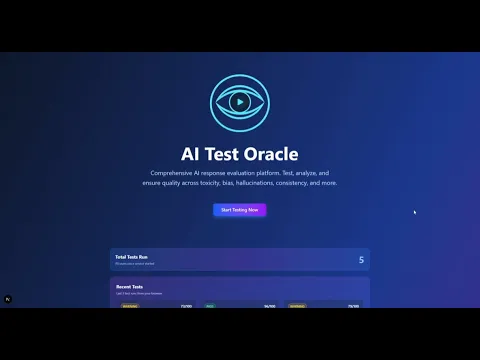
Check out this video where you can see what I meant above \
Github Project Link — feel free to try it out, but only for learning and personal experimentation; selling, reselling, or using it for any other commercial purpose is not allowed.
Questions to you people
- How are you currently validating AI-generated outputs in your projects?
- Would you trust another AI system to evaluate AI-generated content?
- Are we underestimating the long-term QA challenges of generative AI?
Stay ahead of where QA is going
AI is changing QA fast, but most of the conversation online is either panic or hype. If you want something more practical, you can join for occasional emails focused on what actually matters in real projects.
You will get:
- Practical ideas you can apply on AI-heavy products
- Real-world lessons from testing and shipping AI systems
- Actionable checklists, testing strategies, and mental models
- Clear insights without the fear-driven noise
No spam. No recycled LinkedIn advice. No fake urgency. Just useful content for QA engineers trying to adapt, grow, and stay sharp as the industry evolves.
Prefer live chat? Join the QA Evolve Discord server to ask questions, share tips, and talk with other QA engineers working around AI testing and quality.